Industry collaboration / Innovation & systems design / 2025
TOPPAN — Exploring New Business Opportunities Through Design
Six innovation concepts developed through a 100-day university–industry collaboration.
- Year
- 2025
- My contribution
- Collaborative student team member · shared design and prototyping
- Context
- Four-member student team · Keio University SDM, with TOPPAN participants
- Status
- Concept proposals / exploratory prototypes
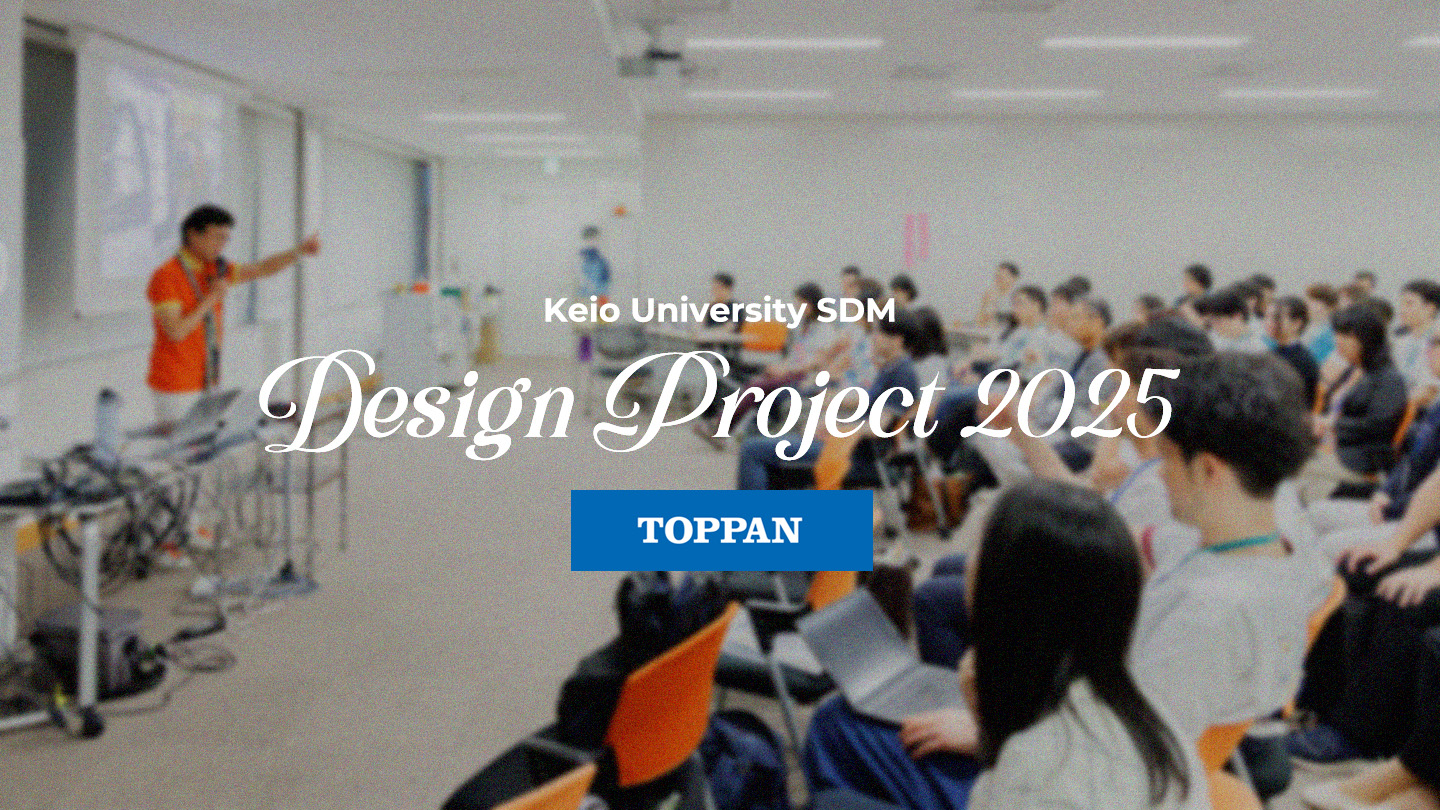
Beyond printing.
As part of my master’s studies at Keio University’s Graduate School of System Design and Management, I worked in a four-member multidisciplinary student team, collaborating with TOPPAN company members. Across roughly 100 days, we explored new products and services, moving from problem exploration to prototypes and proposed business models.
The brief asked how TOPPAN’s established printing-related technologies and assets could be combined with digital approaches to create new value. Our challenge was to connect those capabilities with people’s needs and organisational problems, rather than simply add digital features.
From questions to reasoned proposals.
We worked through the design process together rather than dividing it into fixed individual roles. I took part in discussing assumptions, challenging ideas, exploring possibilities, and jointly developing the proposals.
For each direction, we moved between problem framing, ideation, clarifying value, and testing or modelling a possible solution. Brainstorming and reframing supported exploration; stakeholder analysis, system diagrams and business modelling helped connect each idea to a wider service context.
Small exploratory prototype activities helped us question assumptions. We asked who an idea was for, what needed testing, how it might work as a service, and why it could make sense for TOPPAN.
Different problems. Different directions.
Each concept began with a different question. These six proposals were developed sequentially across the project; they are distinct innovations, not iterations of one product.
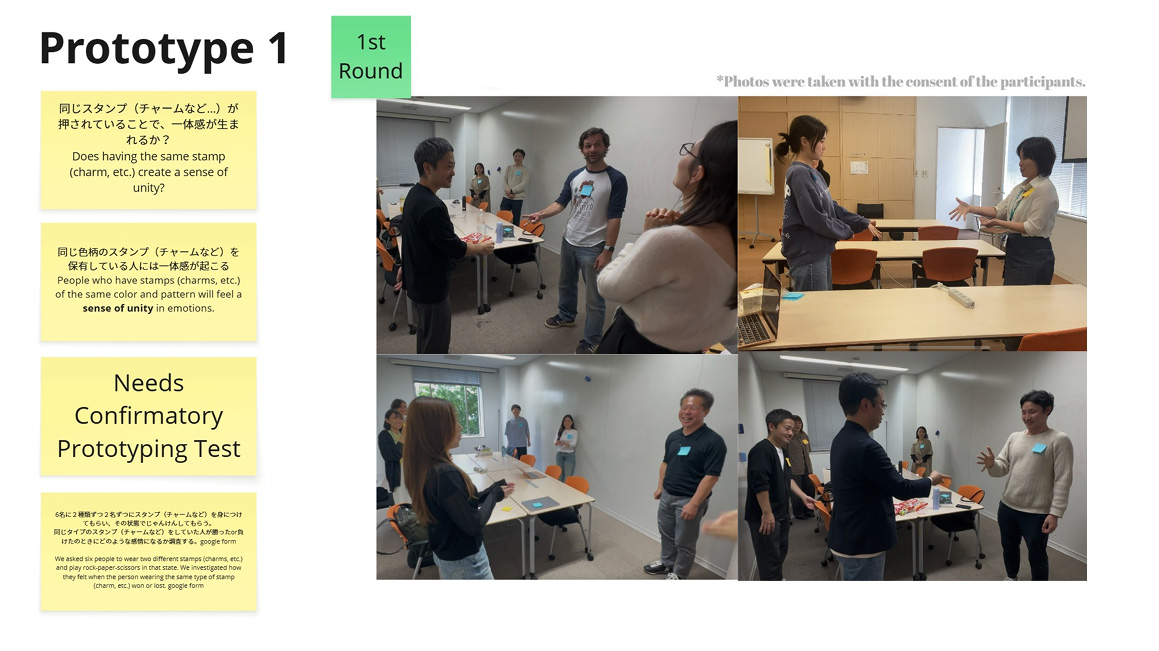
- Concept 01 / Workplace appreciation
Digital Recognition Stamp
Digital stamps and small acts of recognition could help colleagues express appreciation in everyday team interactions. Early prototypes explored people’s responses to giving and receiving acknowledgement.
- Concept 02 / Emotional reflection & sharing
Share-mo
A proposed service for recording and visualising emotions, including location-based sharing on a map. Exploratory testing raised questions about privacy, emotional expression and how people interpret others’ feelings.
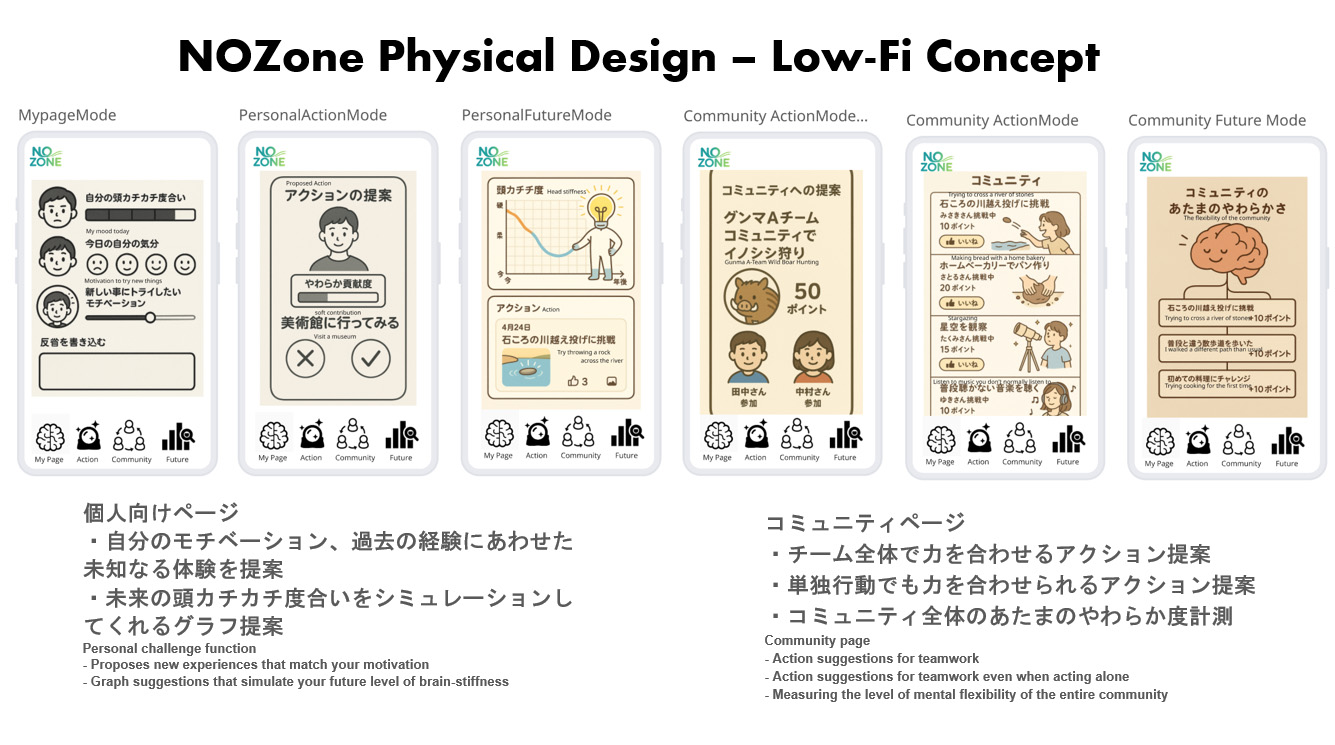
- Concept 03 / Beyond the comfort zone
NoZone
Small unfamiliar experiences and shared challenges offered one possible response to rigid workplace habits. Exploratory activities and feedback helped the team examine what could encourage participation—and what might prevent it.
- Concept 04 / Sensory experience
ZOOLOGIST
A speculative scent-based product-service concept for personal expression and connection. A proposed nasal insert and wearable scent patch were considered together with a wider business ecosystem; they were not built devices.
- Concept 05 / AI-assisted judgment in journalism
umaura
A proposed multimodal service exploring whether verbal and non-verbal interview cues could give journalists additional context. An exploratory exercise examined emotional interpretation; the concept was not validated as a way to establish truth or detect lies.
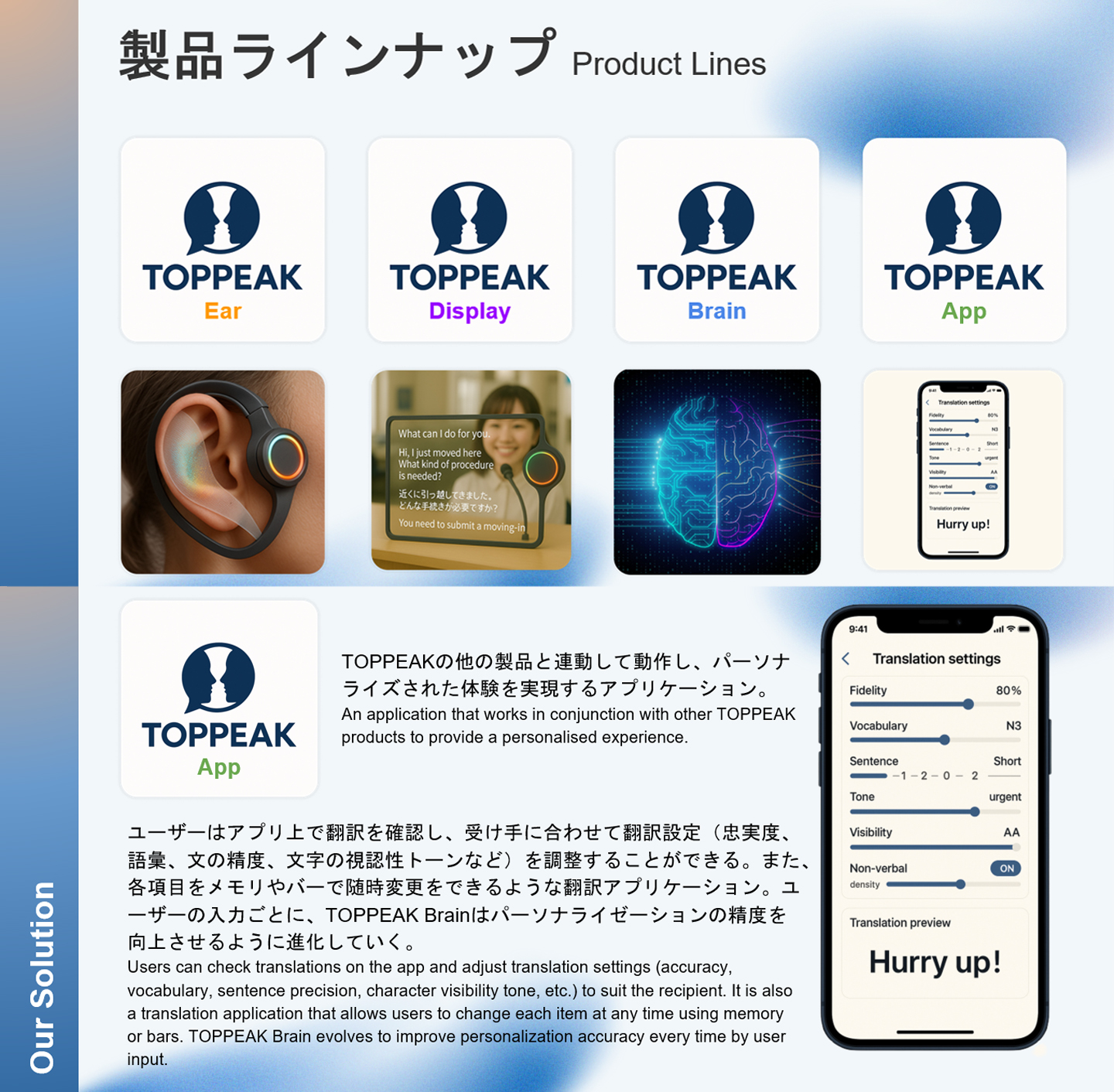
- Concept 06 / Communication adapted to the listener
TOPPEAK
Inspired partly by misunderstandings in our multicultural team, this concept explored adapting messages to the listener’s context and preferences. Proposed app and device touchpoints supported the idea; exploratory exercises examined how simplifying or reframing messages changes meaning.
Working with uncertainty, together.
The most valuable learning was working alongside people who saw problems differently. We had to connect broad questions with practical details, considering users, stakeholders, feasibility and potential business value rather than whether an idea simply sounded interesting.
For me, the project reinforced that design is also about asking better questions, connecting perspectives, and building a reasoned path from a problem towards a possible solution.